



On-Page SEO for ABA Therapy Websites – Optimize Your Website
🔑 Key Takeaways
On-Page SEO Improves Search Visibility
On-page SEO helps Google understand your ABA clinic’s services, locations, and expertise, improving visibility in search results.
Generate Consistent Family Inquiries
A well-optimized website can generate consistent family inquiries without relying solely on referrals or paid advertising.
Fix Common SEO Gaps
Many ABA clinic websites have on-page SEO issues that prevent them from ranking for valuable local search terms.
Optimize Your Homepage
Your homepage should clearly communicate your ABA services, target audience, and service areas to both Google and prospective families.
Dedicated Service Pages Rank Better
Dedicated service pages typically perform better than combining multiple ABA services on a single page.
Create More Ranking Opportunities
Separate pages for Early Intervention, Parent Training, and Autism Assessments create additional opportunities to rank in search results.
Answer Parent Questions
High-quality content that addresses real parent concerns performs better than thin or generic service descriptions.
Build Trust and Authority
ABA therapy websites are healthcare websites, making trust, expertise, and authority essential ranking factors.
Improve Google Ads Performance
Optimized landing pages can improve Google Ads Quality Scores and help reduce advertising costs.
Keep Content Updated
Regular content updates help maintain rankings while ensuring information remains accurate and relevant for families.
SEO Is an Ongoing Process
On-page SEO is not a one-time task—it requires ongoing optimization as your clinic, services, and market evolve.
Turn Your Website into a Lead Source
A strategic on-page SEO approach can transform your website from a simple brochure into a consistent source of qualified ABA therapy leads.
Picture two ABA clinics in the same city. Both have trained BCBAs on staff. Both accept similar insurance plans. Both deliver quality therapy programmes. But one of them gets steady enquiries through their website every week, while the other is waiting for the phone to ring.
The difference usually isn’t reputation, pricing, or clinical outcomes. Nine times out of ten, it comes down to what’s happening on their website — specifically, how well each page is structured to communicate with Google.
That’s what on-page SEO is. And for ABA therapy providers, getting it right is one of the highest-return investments you can make in your marketing.
What On-Page SEO Actually Means for ABA Clinics
On-page SEO refers to everything you do on your own website to help Google understand what each page is about — and to help it decide whether your page deserves to show up when a family searches for ABA therapy in your area.
It’s different from off-page SEO (which covers backlinks, citations, and external signals) and technical SEO (which deals with site speed, crawlability, and server-level issues). On-page SEO lives in the content, structure, and language of each page you publish.
For an ABA clinic, this means your homepage, your services pages, your location pages, your blog posts, and even your FAQ section all need to be written and formatted in a way that tells Google — and families — exactly what you offer, where you operate, and why you’re the right choice.
Most ABA therapy websites we audit at Impactory Media have serious on-page gaps. Not because the clinic owners are careless, but because nobody ever told them what Google actually looks for on a healthcare provider’s website.
The Pages That Matter Most — And Why Most Clinics Get Them Wrong
Every page on your website is an opportunity to rank for a different search term. But some pages carry far more weight than others, and the mistakes clinics make on those pages are often the exact reason their rankings stall.
Your Homepage: The Most Visited, Most Misoptimized Page
Your homepage is almost always the page Google associates most closely with your clinic’s core identity. Yet it’s also the page most clinics treat as a general welcome mat — a place to put a slider image, a tagline, and a “learn more” button.
From an SEO standpoint, your homepage needs to do several things clearly and quickly. It needs to establish who you are (an ABA therapy provider); what you do (Applied Behaviour Analysis, autism therapy, early intervention — whatever services you offer); and where you do it (your city and service area). These aren’t just design choices — they’re signals Google reads to decide when to show your site.
The H1 heading — the main headline at the top of the page — is one of the most important on-page elements on your entire site. If it says something like “Welcome to Bright Futures Therapy” and nothing else, you’ve wasted the single most prominent SEO signal on your most important page. Something like “ABA Therapy in [City] – Specialised Autism Services for Children” tells Google and families exactly what you provide, without being awkward or keyword-stuffed.
Services Pages: Where Most Clinics Leave Rankings Behind
The average ABA clinic website has one services page that lists everything — ABA therapy, social skills groups, parent training, assessments — all bundled together with a few sentences each.
That approach might look tidy, but it’s a missed opportunity. Google ranks pages, not websites. A single page covering five services gives each of those services a fraction of the visibility that a dedicated page for each would produce.
When you build a standalone page for Early Intervention ABA, a separate one for School-Age ABA Services, another for Parent Training, and another for Autism Assessments, you’re giving Google four focused targets to rank instead of one diluted page. Each of those pages can be written to answer the specific questions families search for at each stage, including the relevant terminology BCBAs use, and link internally to related pages on your site.
This is the kind of structural decision that changes rankings over months without requiring a single new backlink.
Location Pages: The On-Page Element ABA Clinics Underuse Most
We covered location pages briefly in our Google rankings article, but they deserve more attention here because they’re fundamentally an on-page SEO tool.
If your clinic serves families in multiple cities – or even multiple neighbourhoods within a large metro – each of those service areas needs its own dedicated web page with genuinely written content. Not the same page with the city name swapped out. Google is good at detecting that, and it won’t reward it.
A well-built location page for ABA therapy goes beyond just naming the city. It references the local community — the school districts in that area, any regional autism resources families might recognise, and the neighbourhoods your clinic serves — and it includes natural language around “ABA therapy in [city]”, “autism services near [neighbourhood]”, and similar terms. That specificity is what earns local rankings.
The On-Page Elements That Directly Affect Your Rankings
Beyond page structure, there are specific on-page components that Google pays close attention to. Understanding these makes it much easier to see why one page ranks and another doesn't.
Title Tags
Title tags are the clickable blue links you see in Google search results. They're one of the strongest on-page ranking signals, and also the first impression families get of your page before they click. Every page on your website should have a unique, descriptive title tag that includes your target keyword and, where relevant, your city. A page titled "Services" tells Google almost nothing. A page titled "ABA Therapy Services for Children – [City], [State]" tells Google a great deal.
Meta Descriptions
Meta descriptions don't directly influence rankings, but they influence whether someone clicks your result over a competitor's. For ABA clinics, a good meta description speaks to what a parent is feeling — the urgency, the hope, the need to find the right provider — and gives them a reason to click.
Header Tags (H1, H2, H3)
Header tags (H1, H2, H3) create the outline of your page. The H1 is your main headline — there should only be one per page, and it should include your primary keyword naturally. H2s and H3s break the page into scannable sections and give Google additional context about what the page covers. Using them well is both an SEO practice and a readability practice.
Image Alt Text
Image alt text is the written description attached to every image on your site. It serves two purposes: it helps visually impaired users understand what an image shows, and it gives Google another signal about your page's content. Most clinic websites either leave alt text blank or write something generic like "photo1.jpg." Describing the image accurately — "BCBA working with a child during ABA therapy session" — is a small but meaningful optimization across dozens of images.
Internal Linking
Internal linking is how you connect pages on your own website to one another. When your homepage links to your services pages, and your services pages link to your location pages, and your blog posts link to relevant service pages, you're creating a web of signals that helps Google understand which pages are most important and how they relate to each other. Most ABA clinic websites have almost no intentional internal linking — which means Google has to guess at the structure on its own.
URL Structure
URL structure matters more than most people realize. A URL like
/services/aba-therapy-los-angeles
tells both Google and visitors exactly what the page is. A URL like
/page?id=47
tells them nothing. Clean, descriptive URLs are a small change that adds up across an entire website.
/services/aba-therapy-los-angeles
/page?id=47
Content Quality: The Part That's Harder to Shortcut
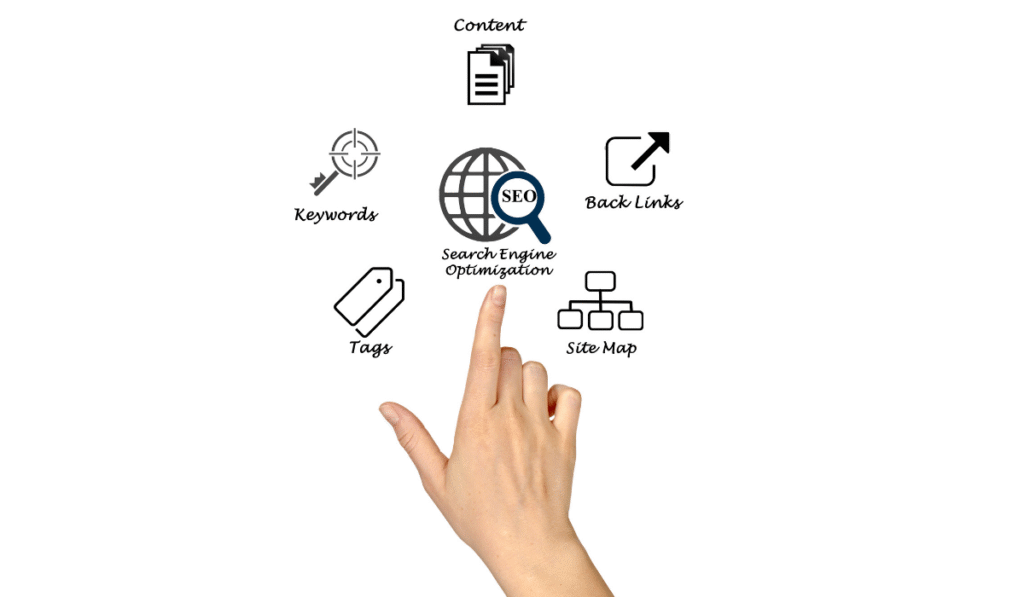
All the technical on-page elements above matter – but they’re multiplied by the quality of the actual content on the page. Google’s ability to evaluate whether a page genuinely answers a searcher’s question has improved dramatically over the past few years. Thin pages with a few hundred words and the right keyword sprinkled throughout don’t rank the way they used to.
For ABA therapy websites, substantive content means pages that actually explain what your services involve — not just that you offer them. A parent reading your Early Intervention page shouldn’t be left wondering what a session looks like, what the typical duration of a programme is, or whether their three-year-old is the right age for your services. Content that answers real questions is content that ranks and converts.
This is where the term ‘E-E-A-T’ comes into play – Experience, Expertise, Authoritativeness, and Trustworthiness. Google uses these signals to evaluate whether a page should rank for health-related searches. ABA therapy falls squarely into what Google classifies as “Your Money or Your Life” content, meaning the bar for quality is higher than it would be for a lifestyle blog or a product review site.
Adding therapist credentials, clinical references, real descriptions of your methods, and transparent information about your intake process all contribute to how Google reads your site’s authority. These aren’t just nice additions — they’re ranking factors for healthcare providers.
Keyword Placement: Natural, Not Mechanical
One of the most common mistakes we see in DIY clinic SEO is keyword stuffing — writing a page that repeats “ABA therapy in [city]” so many times it reads as if a robot wrote it. Google penalises this, and families certainly won’t keep reading it.
Natural keyword placement means including your primary terms where they fit organically: the H1, the opening paragraph, one or two subheadings, within the body text where relevant, in the image alt text, and in the meta title and description. Beyond that, the focus should be on writing for the human reader first.
Related terms — what SEO professionals call semantic keywords — matter just as much as exact-match keywords now. Words and phrases like “applied behaviour analysis”, “autism spectrum disorder”, “behaviour intervention plan”, “BCBA”, “early intervention services”, and “insurance-covered therapy” all add topical depth to your page and help Google understand that your content genuinely covers the subject.
How On-Page SEO Connects to the Rest of Your Marketing
On-page SEO isn’t a standalone project. It works best when it’s part of a broader strategy that includes your Google Business Profile optimization, your local citation building, your content marketing, and your paid search campaigns.
A well-optimized website page is the destination for every marketing channel you run. If your Google Ads are driving clicks to a poorly structured landing page with no clear call to action and vague service descriptions, you’re paying for traffic that converts poorly. If your Google Business Profile is sending local searchers to a homepage that doesn’t make it easy to contact you, you’re losing families at the last step.
That’s why at Impactory Media, we treat on-page SEO as foundational — something we build before we layer on any other marketing activity. It’s the difference between running water uphill and letting it flow naturally.
What an On-Page SEO Audit Looks Like for an ABA Clinic
The clinics we work with don't just see rankings improve. They see better-quality inquiries come through — families who arrive on the website already understanding what ABA is, who your clinic serves, and how to get started. That's what good on-page content does. It pre-qualifies the people who contact you.
Your Website Should Be Working as Hard as Your Clinicians Are
Every day your website sits with unoptimised pages, you’re leaving enquiries on the table — families who searched, found a competitor’s cleaner, better-ranked page, and made a call that could have been yours.
On-page SEO isn’t a one-time fix or a technical add-on. For an ABA therapy centre competing in any local market, it’s the foundation of your entire digital presence. Getting it right changes what your website does for your clinic — from a digital brochure nobody reads to a consistent source of qualified family enquiries.
Impactory Media works exclusively with ABA therapy providers. If you'd like to know exactly what's holding your current website back, reach out and we'll start with a straightforward audit — no sales pressure, just clarity on where you stand and what it would take to improve.
Get Your Website AuditFrequently Asked Questions